
General Purpose Clutches
for Gas and Diesel Engine Driven Components
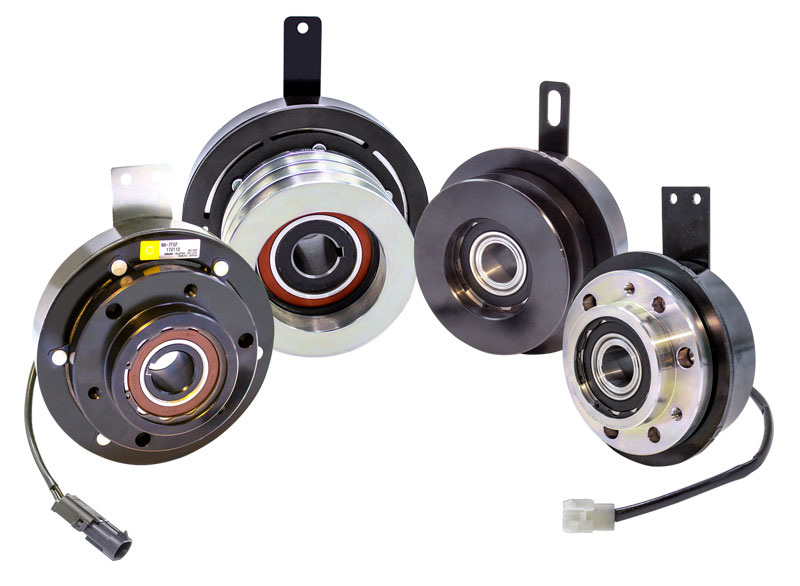

ELECTOMAGNETIC GENERAL PURPOSE CLUTCHES
for Gas and Diesel Engine Driven Components
Ogura general purpose electric clutches provide reliable performance for long life applications. These clutches are designed to mount directly to a gas or diesel engine shaft. They are used in many outdoor power equipment applications, such as stump grinders, pump jacks, fan and straw blowers, or in salt & sand spreaders. Ogura general purpose electromagnetic clutches can handle almost all direct engine mount clutch requirements in the 5 horsepower to 40 horsepower range. They are also ideally suited for outdoor applications in the agricultural, construction equipment, oil and gas field and power generation markets. Designed to transfer rotary motion directly from an engine, Ogura clutches feature standard crankshaft bore sizes and torque ratings to handle a variety of engines. A wide selection of forged machined pulleys or universal mounting output hubs provide a variety of connection options.
Featuring a solid forged rotor, high temp/long life bearings and e-coat corrosion protection, Ogura general purpose clutches can tackle the most demanding applications.
Remote actuation
The clutch can be engaged or disengaged from a remote location such as the cab in a truck or a control panel.
Safety
In cases where the clutch is driving applications such as a stump grinder or a trencher, many times these can be fitted with an operator presence control so if the operator lets go of the handle, the clutch automatically disengages. Since electric clutches are not speed dependent, they can be engaged and disengaged at any point in their speed range.
Reduced power consumption from the engine
Since the clutch is only engaged when it is required to run, engine horsepower can be utilized for other functions when the clutch is not driving. This is particularly important if horsepower is required to perform an independent driving function or in applications such as fans or blowers that consume a lot of horsepower and do not need to run all the time the engine is running.
Simple installation
Since the clutch runs directly off the battery, all that is required is a basic switch to engage and disengage the clutch.
Operator convenience
Rather than a mechanical linkage which can cause an additional force required by an operator to engage a clutch, an electric clutch is engaged by a simple flip of a switch. Because the clutch is engaged electrically, this switch can be incorporated into a control panel so the operator does not have to be in the same location as the clutch when it engages.
Cold weather starting
By using a clutch, the load is not engaged at start up. This allows the engine to come up to full efficiency before engaging the clutch. This helps to prevent engine stalling.
How General Purpose Electromagnetic Clutches Work
Principles of Operation
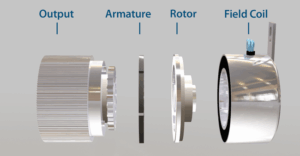
Field/rotor assembly This is the coil and backing plate. The coil provides the magnetic flux that allows the clutch to pull in. The rotor provides the input rotation as it is normally connected to an input shaft.
Pulley/armature assembly This includes the armature disk, springs, hub and pulley. This is normally the output of the clutch. In some instances, a mounting flange is used instead of a pulley.
In a general purpose clutch, either the pulley/hub or the bore (rotor) of the clutch can be the input. In most cases, the bore (rotor) is the input. This input is normally mounted directly on an engine shaft.
All general purpose clutches are bearing mounted. This means that the field is supported by a bearing on the shaft and does not have to be mounted separately. Some mobile clutches are one piece designs and some are two piece (the field/rotor is one part and armature/pulley is the other).
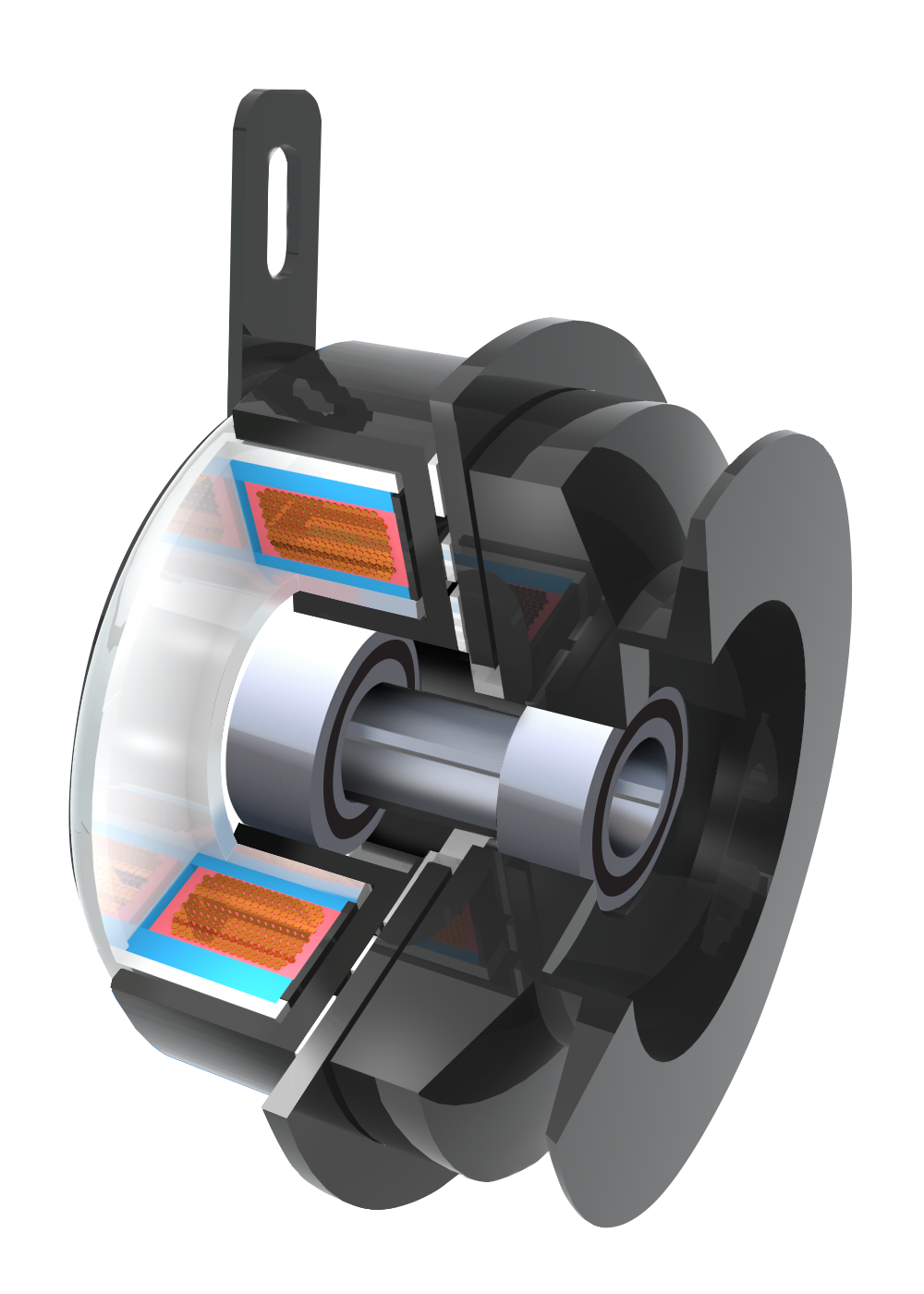
Engagement of the armature to the rotor is caused by the magnetic attraction between the rotor and the armature. The magnetic flux is transferred from the field into the rotor and then into the armature. The slots in the rotor and the armature are called banana slots. These slots allow the flux to contact the rotor and the armature in more than just two places. (A normal magnet only has a north and a south point of attraction.) By making multiple points of flux connection, the torque can be increased in this type of clutch.
The picture shows a standard clutch. It has three flux paths. This is called a triple flux or a six-pole design.
To disengage the clutch, the voltage going to the coil is simply turned off. Once the voltage is released, the springs between the armature and the hub pull the armature away from the rotor, creating an air gap so no contact is made when the clutch is turned off.
Ogura Design Advantages
Solid forged rotor
A one piece solid forged rotor means no chance of internal parts separation. Our rotors also have an even wall thickness around the coil which gives optimum flux distribution, maximizing torque.
Different coil voltages available
Although 12 volt is the most common, 24 volts can also be made available. Depending upon the quantity, other specialty voltages can be made
High temperature, longer life grease
All models include our special long life grease which has shown a significant improvement in life over other standard high temp greases.
E-coating
Where possible, all parts in the clutch are e-coated to give maximum corrosion protection.
High temperature epoxy coil
To help prevent failure from both vibration and outside contaminants, all coils are sealed in the coil shell with a high temperature epoxy coating.
Forged machined pulley
All models in this section use a heavy duty machined pulley. A stronger pulley resists damage due to abusive environments.